
 This is the second in a series of posts on taking notes and managing your work with OneNote. For an introduction to OneNote, click here.
If you have used social bookmarking tools like Diigo or Delicious, note taking software like Evernote, or even created a blog, you are probably familiar with tagging. Typically, you tag a note, webpage or blog post to categorize it. You might for example assign the tag “recipe” to web pages and notes containing recipes.
Where are tags used in OneNote?
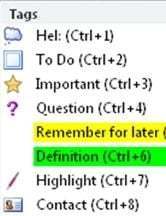
OneNote tags are usually not applied to categorize whole documents or pages (for this you use notebooks, section groups and sections), but to mark individual items (e.g. headings, paragraphs, sentences, or even images) on pages.
OneNote includes a large number of predefined tags, allowing you to label items according to their type, or what you need to do with them. In addition to predefined tags, you can also create your own.
Read moreOneNote Tags are Special: Use them to Manage Work and Study

 With many people now owning a PC, a tablet, and a smartphone, Dropbox has become a very popular service to keep files in sync. You place your files, folders and subfolders in your PC’s Dropbox folder, and they should in principle be available in the cloud and on every other device with an installed Dropbox app.
 Learning a foreign language is one the most rewarding and beneficial learning tasks I can think of. Even if you only have the time to learn the basics, you get such a boost in cultural understanding and ability to move around in a foreign land. As of today, I am fluent in three languages, and have learned two more to a level where I can express myself and get everything I need in daily life. Ideally, you want to learn a foreign language in a country where it is spoken, however most people initially encounter their first foreign language in school.
 Yesterday, I was lying in my bed, ready to go to sleep, but my mind wasn’t yet. A few ideas for upcoming blog posts popped up, and I surely wasn’t going to let them go. Not wanting to get up again, I quite literally stored them in my brain – in a small mnemonic filing system.
 I have been learning Chinese on and off since 2001. To this day, I am still intrigued by Chinese writing, and I highly recommend learning Chinese characters to anyone who wants to stay in China, Hong Kong, or Taiwan for any prolonged period of time. Even if you don’t intend to live in China, learning Chinese can be incredibly beneficial: